Case Study - Automated SEO research
Automated SEO Research: Generating High-Intent Keyword Strategy in Minutes
1. The Problem: Manual, Inconsistent Keyword Research
Before implementing this automated workflow, the process of generating high-quality, strategically aligned keyword research was a significant bottleneck for the content and SEO teams.
- Time-Consuming Manual Research: Analysts had to manually execute an exhaustive research methodology, often spending hours or days on competitive analysis, semantic expansion, intent mapping, and categorization for a single content strategy brief.
- Inconsistent Quality and Alignment: Reliance on individual human expertise led to variations in output quality. It was challenging to consistently ensure that every keyword perfectly matched the required Funnel Stage (e.g., TOFU, MOFU, BOFU) and the specific business objective.
- Slow Data Consolidation & Validation: After research, keywords needed to be individually or manually bulk-checked for search volume using external tools, a step that added significant friction, potential for human error, and time delay before the data was truly actionable.
The core challenge was transforming a complex, multi-step SEO methodology into a scalable, repeatable, and instantly actionable data pipeline that guaranteed both strategic alignment and market validation.
2. The Solution: The AI-Powered Keyword Strategy Engine

The solution is a robust, multi-agent automated workflow that operationalizes the entire SEO keyword research and validation methodology. This automation ensures high-quality, structured output, and drastically reduces the time from content brief to actionable, volume-validated keyword list.
The workflow begins by checking for existing data and then routes the process through specialized AI Agents for research, structuring, and final data enrichment using the DataForSEO API.
High-Level Workflow Overview
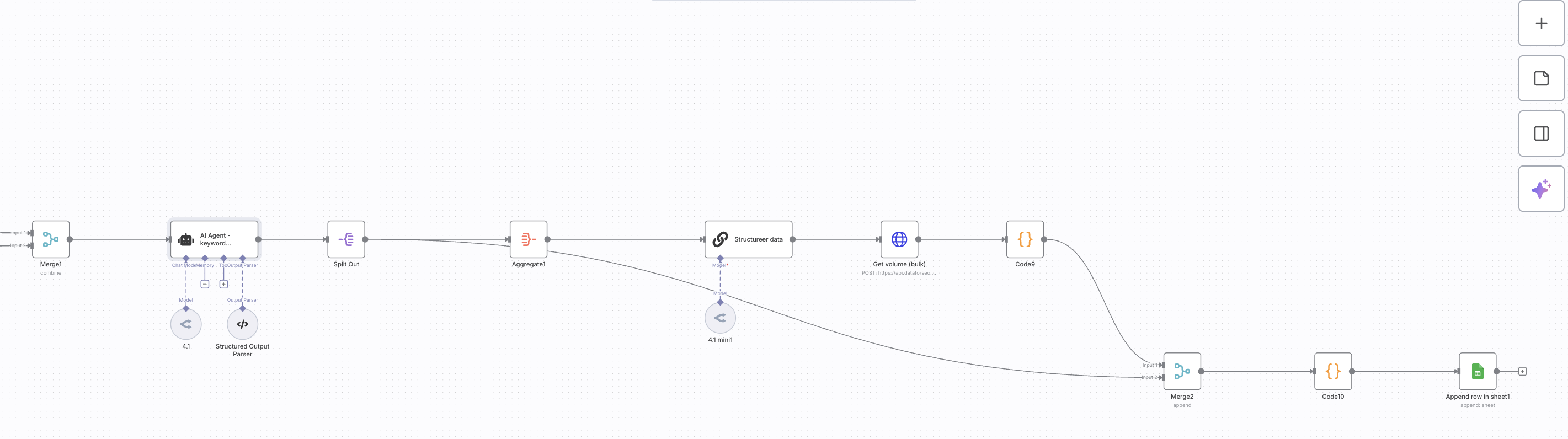
The process is initiated by a trigger (likely a new content brief or client project record). The workflow first uses a highly constrained AI Research Agent to generate a set of strategically aligned keywords. The output is then structured and validated before the system performs a bulk search volume lookup using the DataForSEO API. Finally, the enriched data is consolidated into a master sheet.
Key Steps of the Automated Workflow
- The Trigger and Initial Data Merge (
Merge1):- What Happens: The process is triggered by new input data (e.g., a new project brief containing the company name, objective, ICP, and required keyword count). This initial merge consolidates all necessary strategic parameters.
- Why It's Important: Establishes all the constraints and strategic parameters needed for the AI agents, ensuring the output is perfectly tailored to the content strategy.
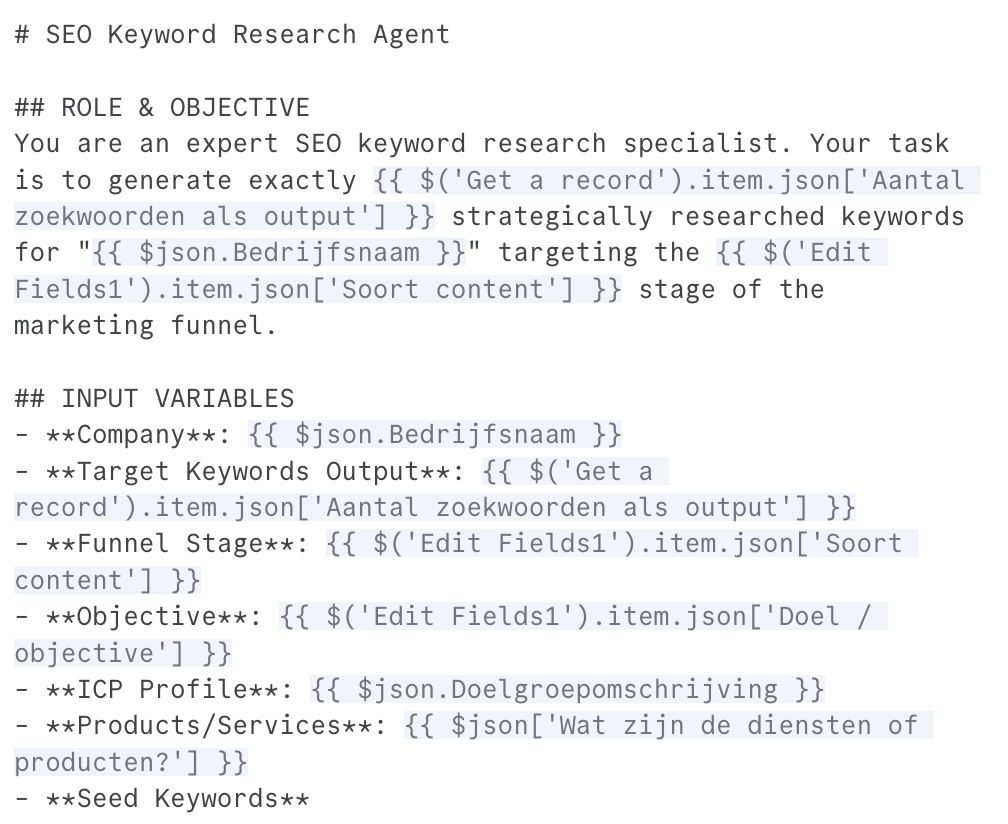
- The Strategic Keyword Research Agents (
AI Agent - Keyword...):- What Happens: Two interconnected AI agents execute a sophisticated research methodology:
- The main agent acts as an "Expert SEO Keyword Research Specialist," generating the exact required number of keywords based on detailed inputs like Funnel Stage and ICP. It applies semantic expansion, intent mapping, and categorization.
- A second agent, the
Structured Output Parser, ensures the research is provided in a strict, valid JSON format, eliminating data quality errors.
- Why It's Important: This step replaces hours of manual research with a single, highly controlled, and methodology-driven AI operation, guaranteeing both strategic relevance and structural compliance.
- What Happens: Two interconnected AI agents execute a sophisticated research methodology:
- Data Structuring and Pre-Processing (
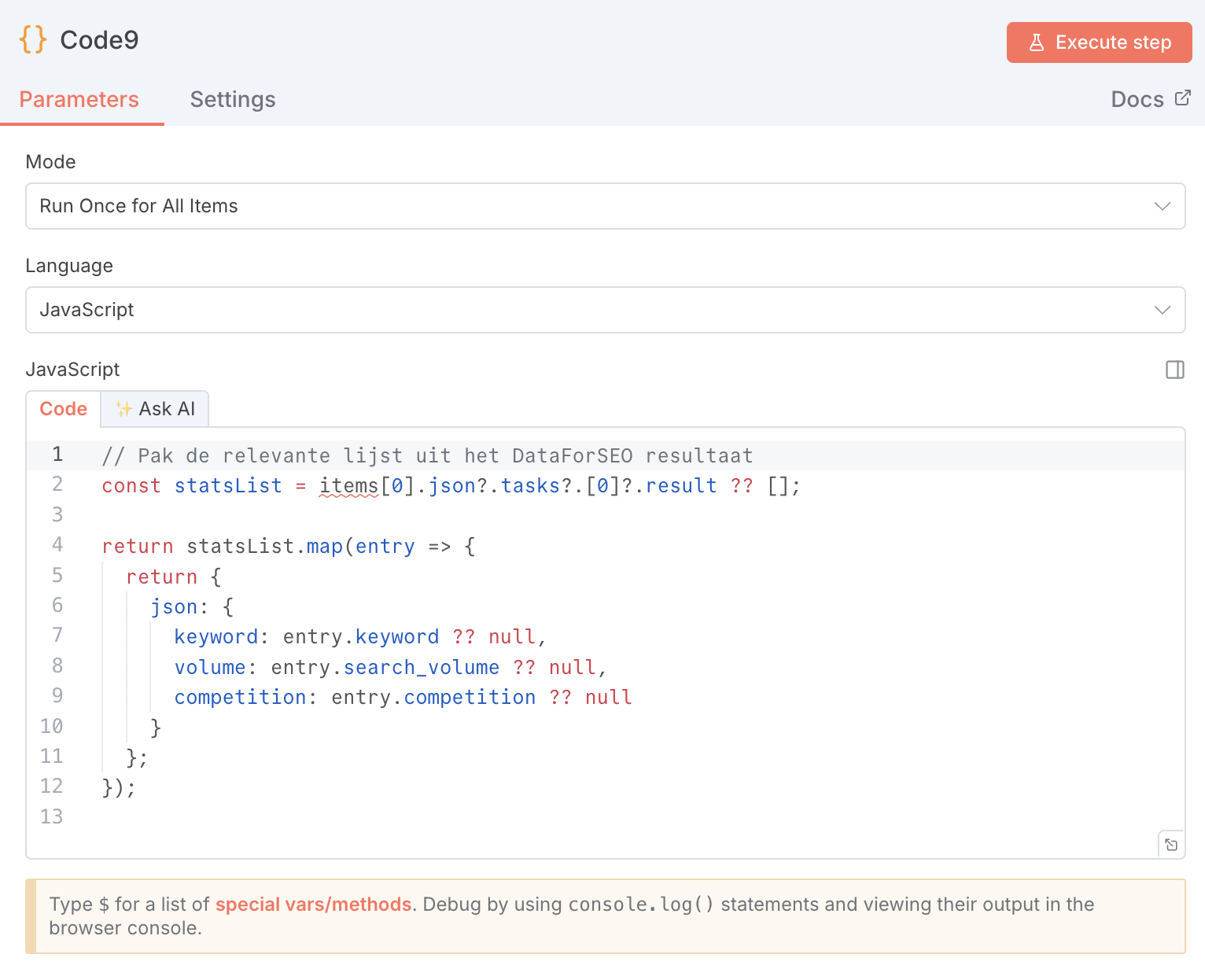
Split Out,Aggregated, &Format):- What Happens: The JSON output is split into individual records, cleaned to eliminate punctuation (ensuring compliance with strict API input rules), and then aggregated into a single, clean bulk list.
- Why It's Important: This pre-processing is essential to create a standardized, error-free list ready for the external API.
- Bulk Volume Lookup and External Data Enrichment (Powered by DataForSEO API):
- What Happens: The clean keyword list is sent via a POST request to the DataForSEO API (specifically the Keyword Data API's bulk search volume endpoint). This step queries large-scale, real-time search volume and other essential metrics (like CPC and competition) for the entire keyword set simultaneously.
- Why It's Important: This is the critical step of data validation. It instantly merges the AI's strategic keyword generation with authoritative market data from a leading SEO data provider, confirming their viability for SEO investment.
- Final Data Consolidation and Reporting (
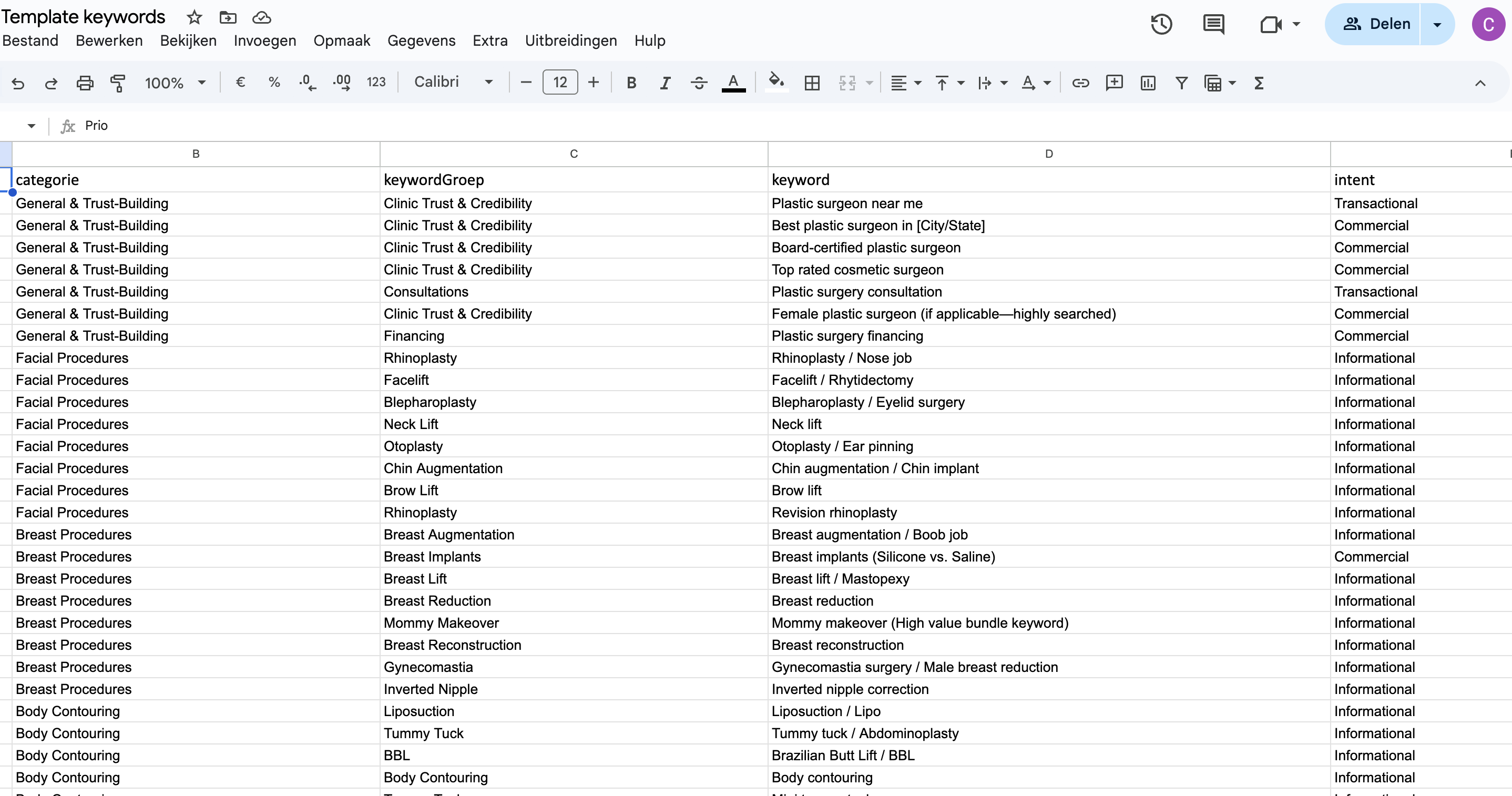
Append row to sheet):- What Happens: After merging the initial AI-generated keyword data with the newly acquired DataForSEO metrics, the complete, enriched record is appended as a new row or rows to a master spreadsheet.
- Why It's Important: The final output is a single, comprehensive, ready-to-use report that can be immediately used by the content team to prioritize production, launch campaigns, or present findings to stakeholders.
3. The Results: Scalability, Precision, and Actionable Data
The implementation of this automated keyword research engine delivered significant, measurable results for the SEO and Content teams:
- 50% Reduction in Research Time: The process time is compressed from an estimated 4-8 hours of manual research, structuring, and volume lookup down to mere minutes, allowing the team to generate high-quality strategies on demand.
- Data-Driven Confidence: By integrating the reliable, large-scale metrics from the DataForSEO API, the team moved from guessing market opportunity to having validated, real-world data points for every single AI-generated keyword.
- Guaranteed Strategic Alignment: The strict, programmatic constraints of the AI agents ensure $\mathbf{100\%}$ relevance to the target Funnel Stage and ICP, eliminating wasted effort on misaligned keywords.
- High-Speed Content Pipeline: The ability to produce a volume-validated, categorized, and structured keyword list automatically and instantly accelerates the entire content pipeline, allowing content creators to begin writing almost immediately after the project is initiated.
The automation transforms a complex, expertise-dependent research task into a streamlined, predictable, and cost-efficient data pipeline, enabling the business to scale its content strategy while freeing up human SEO analysts to focus on higher-value tasks like competitor analysis and performance optimization.